
A second mortgage is exactly what it sounds like: a second lien on your property, taken out while your first mortgage is still active. It lets you borrow against your home's equity without refinancing your primary loan. There are two common types: the home equity loan and the home equity line of credit (HELOC). They work very differently, and choosing the wrong one for your situation costs real money.
Home Equity Loan vs. HELOC
A home equity loan is a lump-sum fixed loan. You borrow a set amount at a fixed interest rate and repay it over a set term, usually five to fifteen years. The payment is predictable. This works well when you have a defined expense: a home addition, a debt payoff, a specific project where you know the total upfront.
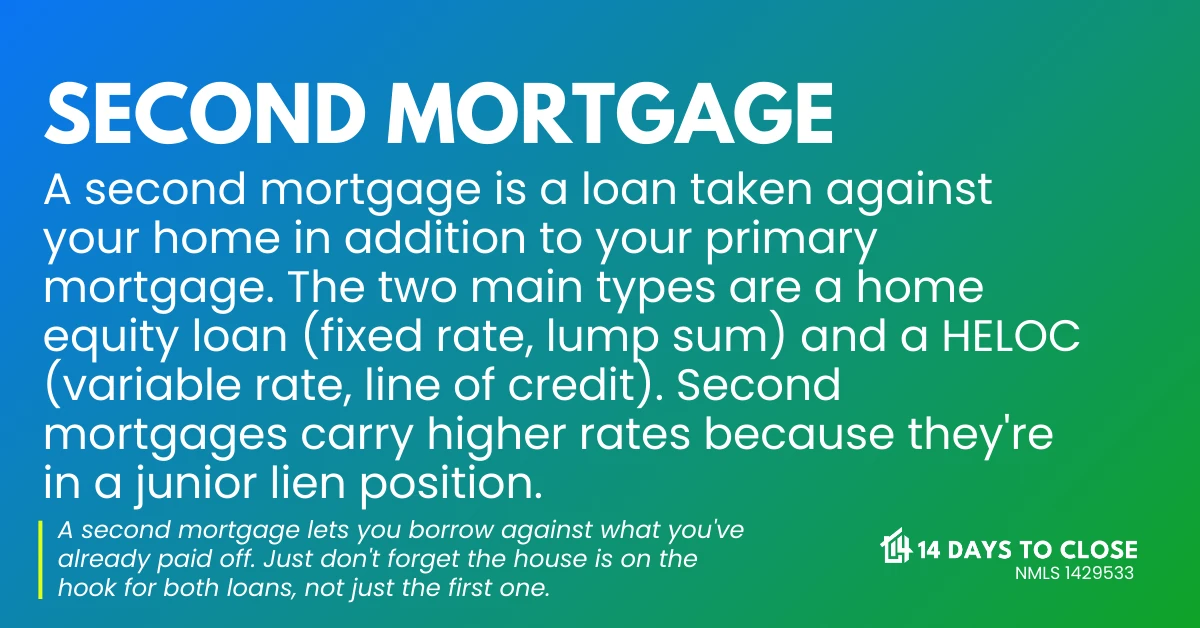
A HELOC is a revolving line of credit with a variable rate. During the draw period (typically ten years), you can borrow, repay, and borrow again up to the limit. You pay interest only on what you've drawn. After the draw period, the repayment period begins and the balance must be paid down over ten to twenty years. The HELOC's flexibility makes it useful for phased projects or situations where the total cost is uncertain. The trade-off is variable rate risk: if rates rise significantly, your HELOC payment rises with them.
What Qualifies You for a Second Mortgage
Lenders require sufficient equity, typically at least 15 to 20 percent remaining after the second mortgage is added. If your home is worth $450,000 and you owe $300,000 (67% LTV), you might access up to $60,000 in a second mortgage while staying below the 80% combined LTV threshold.
You'll also need a qualifying credit score (typically 620 to 680 minimum), acceptable debt-to-income ratio, and income documentation. Second mortgages are fully underwritten loans, not automatic approvals. Lenders treat them seriously because they're in second position: if you default, the first mortgage lender gets paid before they do.
Second Mortgage vs. Cash-Out Refinance
If you already have a low interest rate on your first mortgage and don't want to lose it, a second mortgage lets you access equity without touching the first loan. A cash-out refinance replaces the first mortgage entirely. That's useful if current rates are similar to or lower than your existing rate, but counterproductive if you're sitting on a 3.5% rate from 2021.
The math is straightforward: if you have a $300,000 balance at 3.5% and want to access $50,000 in equity, refinancing the whole $350,000 at today's rate may cost significantly more per month than keeping the first mortgage and adding a $50,000 second mortgage at a higher rate. Run both scenarios before deciding.
Second Mortgage or Cash-Out Refi?
We'll run both scenarios side by side with your actual numbers. There's a clear winner for most situations, and we'll show you which one it is.
Compare My OptionsWhen a Second Mortgage Makes Sense
Second mortgages make the most sense for homeowners who want to access equity without refinancing a favorable first mortgage rate. Common uses: funding home improvements that add value, consolidating higher-rate debt like credit cards or personal loans, financing education expenses, or bridging a financial gap when other liquidity is tied up.
They're less appropriate when the monthly payment on the second mortgage would stretch your budget to its limit, when rates on the second mortgage are so high that debt consolidation doesn't actually save money, or when the purpose is consumption spending that doesn't add lasting value. Understand the risks of borrowing against home equity before committing to either product.
Florida Tax and Legal Considerations
Interest on a second mortgage used for home improvement is generally tax-deductible, subject to IRS limits. Interest used for other purposes: debt payoff, education, general expenses, may not be deductible. Consult a tax professional for your specific situation before factoring deductibility into your math.
Florida's homestead exemption provides creditor protection for your home equity generally, but second mortgage lenders are secured creditors. If you default on a HELOC or home equity loan, the lender can pursue foreclosure. That's the trade-off for the lower rate: your home is the collateral.
At 14 Days To Close, we can compare a second mortgage versus cash-out refinance for your specific situation. Give us a call or start at go.14daystoclose.com/apply-now.