
There's no single credit score requirement for getting a mortgage. The minimum depends entirely on the loan type, and even then, the lender you choose adds another layer on top. Here's what actually matters, broken down by program.
Conventional Loans: 620 to 740+
Conventional loans sold to Fannie Mae or Freddie Mac require a minimum 620 credit score. But 620 gets you in the door, not the best terms. The pricing grid for conventional loans is tied closely to your score. A 740 and above typically gets you the best rate. Between 680 and 739, you're paying modestly more. Below 680, the adjustments start adding up.
Conventional loans also price in your loan-to-value ratio alongside your score. A 650 score with 20 percent down looks very different to a lender than a 650 score with 5 percent down. For a full breakdown, see our guide to credit score requirements for conventional loans.
FHA Loans: 500 to 579 (10% Down) or 580+ (3.5% Down)
FHA's official minimums are 500 with 10 percent down and 580 with 3.5 percent down. In practice, most FHA lenders impose overlays: their own internal minimums that sit above FHA's floor. The practical minimum at most lenders is 580 to 620.
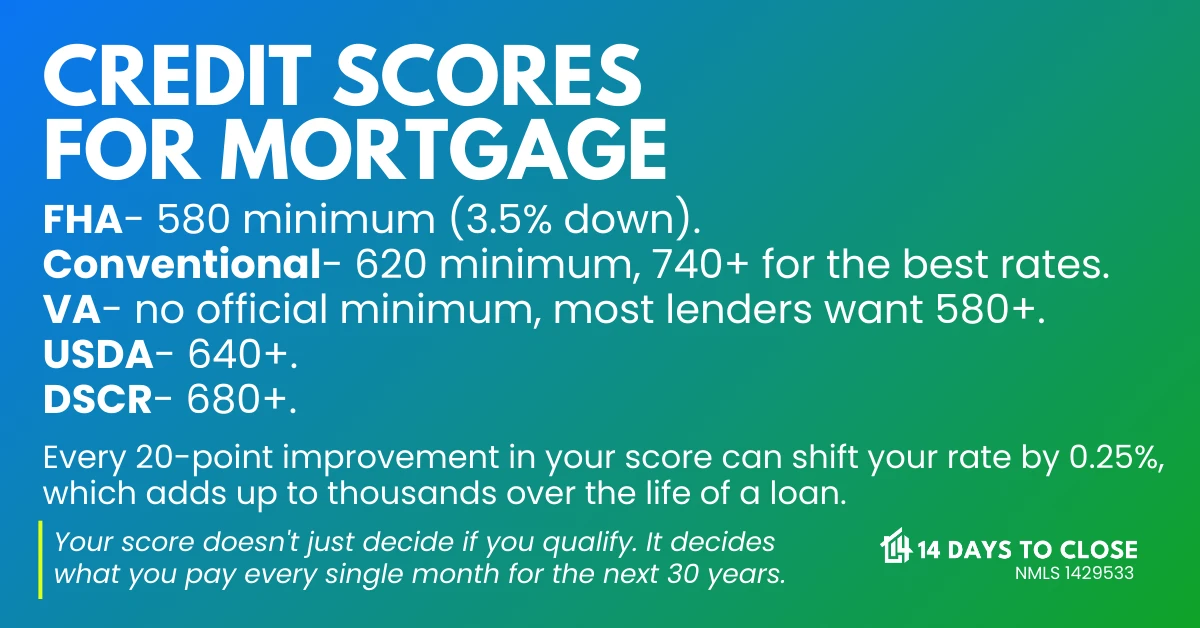
FHA loans are worth considering even if your score is above 700. They offer lower down payment options and more flexible debt-to-income ratios. For a full picture of how FHA programs work in Florida, see our guide to FHA loan limits and requirements in Florida.
VA Loans: No Official Minimum
The Department of Veterans Affairs doesn't set a minimum credit score. Individual lenders do. Most VA lenders want to see at least a 580 to 620, with 620 being the most common practical floor. VA loans are among the most flexible products available, partly because the VA guarantee reduces lender risk significantly.
If you've served and have a credit score in the 580s, VA is often the best path forward: better terms than FHA and no mortgage insurance premium.
USDA Loans: 640 Recommended
USDA loans for rural and suburban properties have a 640 recommended score for automated underwriting approval. Below 640, your file goes to manual underwriting, which isn't a disqualifier but does mean more scrutiny and documentation. USDA is a zero-down loan, which makes the credit requirements fairly competitive for what you're getting.
Jumbo Loans: 700+
Jumbo loans, mortgages above the conforming loan limit, are held by lenders rather than sold to agencies, which means lenders set tighter requirements. Most want to see 700 to 720 minimum, with some requiring 740 or higher. Down payment requirements are also more substantial, typically 10 to 20 percent.
Not Sure Which Program Fits Your Score?
We'll look at your full picture, not just the number, and find the right loan type for your situation. Your score is one input, not the whole story.
Check My Loan OptionsLender Overlays: The Layer Nobody Talks About
Here's what most buyers don't realize: even when a program allows a 580 score, many individual lenders won't go below 620 or 640. These are called overlays: the lender's own requirements on top of the program's. They exist because lenders carry risk on loans until they're sold, and some choose to reduce that risk by tightening their own minimums.
This is why a denial from one lender doesn't mean every lender will say no. Different lenders have different overlays, different risk appetites, and different products. A mortgage broker can shop your file across multiple lenders with different requirements, which is exactly why getting a second opinion when you're denied makes sense.
What If You're Right at the Minimum?
If your score is right at the minimum for a program, it's worth pausing to ask whether a quick bump in score changes anything. Paying down a credit card from 80 percent utilization to below 30 percent can add 20 to 40 points in 30 to 60 days. That might move you from one pricing tier to a meaningfully better one.
At 14 Days To Close, we look at your full picture before recommending a loan type. Your credit score is one input. The loan type, the lender, the down payment, and the program all shape the final rate and terms as much as that number does. Give us a call to talk through your situation.