
Choosing the right mortgage matters as much as choosing the right home. The loan type you end up with affects your down payment, your monthly payment, how much mortgage insurance you pay, and how quickly you can close. FHA, VA, USDA, conventional, and jumbo all have different rules, and picking the wrong one means leaving money on the table or disqualifying yourself unnecessarily.
Here's a plain breakdown of each loan type, what it's actually for, and how to figure out which one fits your situation. If you want to compare the two most common options side by side, see our VA vs. FHA breakdown for Florida buyers.
Conventional Loans: The Standard Choice
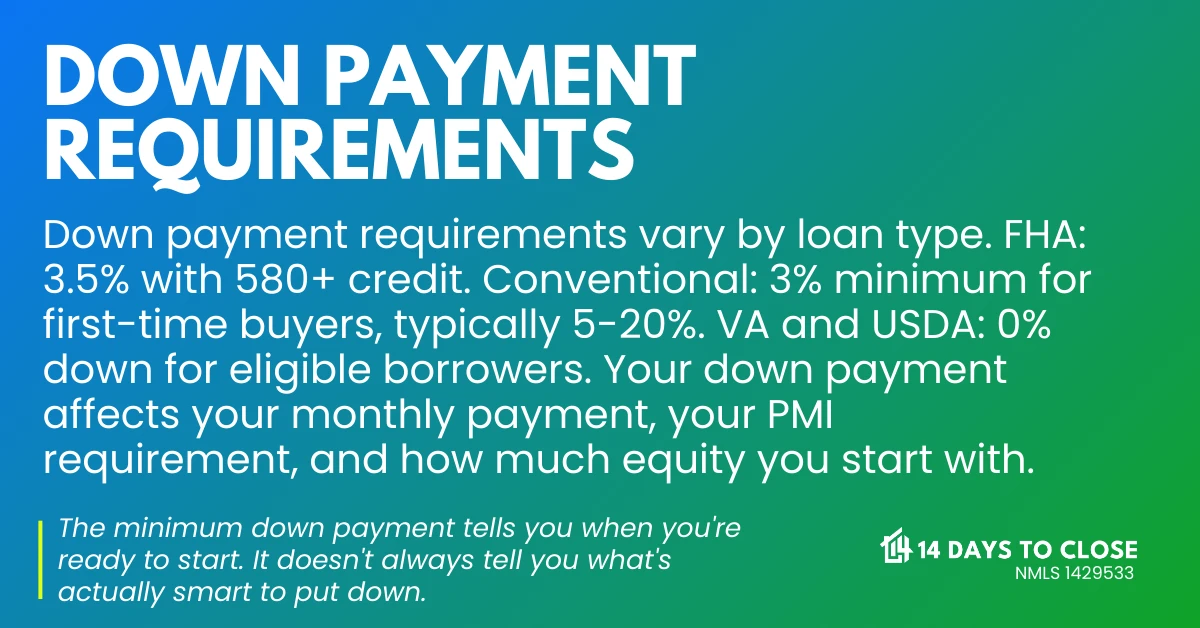
Conventional loans aren't backed by the federal government, which means lenders hold more of the risk and set stricter qualification standards. A minimum credit score of 620 is typical, though better scores get better rates. Down payments can go as low as 3% for qualified borrowers.
If you put down 20% or more, you skip private mortgage insurance (PMI) entirely. That's a meaningful monthly savings over the life of the loan. Buyers with strong credit, stable income, and a solid savings history often get the best deal here.
Best for: Buyers with a 620+ credit score and steady income who can put down at least 3% to 5%.
FHA Loans: Built for Buyers with Less
FHA loans are insured by the Federal Housing Administration and designed to make homeownership accessible to buyers with lower credit scores or smaller down payments. The minimum down payment is 3.5% for credit scores of 580 or higher. Scores between 500 and 579 require 10% down.
The trade-off is mortgage insurance. FHA loans require both an upfront mortgage insurance premium and an annual premium paid monthly. That cost doesn't go away once you hit 20% equity, it stays for the life of the loan unless you refinance. Check the current FHA loan limits for Florida counties before you start shopping.
Best for: First-time buyers or anyone with a credit score below 680 who needs a lower barrier to entry.
VA Loans: The Strongest Benefit Available to Veterans
VA loans are available to veterans, active-duty military members, and eligible surviving spouses. They're backed by the Department of Veterans Affairs and come with terms that are hard to beat: no down payment required, no private mortgage insurance, and competitive interest rates.
There is a VA funding fee, which varies based on your service history and down payment amount, but it can be financed into the loan. For eligible buyers, the monthly cost of a VA loan is often lower than a comparable FHA or conventional loan.
Best for: Veterans and active-duty service members who qualify. This is typically the strongest option available if you're eligible.
Not Sure Which Loan You Qualify For?
We'll match you to the right loan type in minutes. No hard pull until you're ready.
USDA Loans: Zero Down for Rural and Suburban Buyers
USDA loans are backed by the U.S. Department of Agriculture and offer 100% financing for eligible buyers in designated rural and suburban areas. No down payment is required. Income limits apply based on household size and location, and the property has to meet USDA eligibility requirements.
Mortgage insurance premiums for USDA loans tend to be lower than FHA. The combination of zero down and lower ongoing costs makes this a compelling option for buyers who qualify. Many areas just outside Tampa and other Florida cities are USDA-eligible, so it's worth checking before you assume you don't qualify.
Best for: Buyers in rural or suburban areas with moderate household incomes who want zero-down financing.
Jumbo Loans: For High-Value Properties
Jumbo loans cover properties that exceed the conforming loan limits set by the Federal Housing Finance Agency. In most Florida counties for 2024, that limit was $766,550. Anything above that amount requires a jumbo loan.
Lenders take on more risk with jumbo loans, so the requirements are stricter: credit scores typically need to be 700 or above, down payments generally run 10% to 20%, and cash reserve requirements are higher. Rates can be competitive, but vary significantly by lender. See our Florida jumbo loan guide for 2025 for current limits and requirements.
Best for: Buyers financing high-value properties with strong credit and larger down payments.
How to Choose the Right Loan
Start with what you can actually qualify for, then compare the total cost over the life of the loan, not just the monthly payment. A lower rate with higher insurance costs can end up more expensive than a slightly higher rate with no PMI.
Key questions to answer first: What's your credit score? How much cash do you have for a down payment and reserves? Are you a veteran? Is the property in a USDA-eligible area? What's the purchase price? Those five answers narrow the field fast.
At 14 Days To Close, we work through all of this upfront so you go into the process knowing exactly what you're working with. No guessing, no surprises at closing. Our clients have thousands of five-star reviews because we make this part straightforward. Understand the difference between pre-qual and pre-approval before you start writing offers.