
Refinancing replaces your existing mortgage with a new one. The new loan pays off the old one, and you start making payments on the new terms. The process is similar to your original purchase mortgage, with a few key differences. The decision of whether it makes sense depends entirely on your numbers, not the headlines.
The First Question: Does the Math Work?
The break-even analysis is the foundation of any refinance decision. If your new rate saves you $150 per month and the closing costs are $4,500, your break-even is 30 months. If you plan to stay in the home at least that long, refinancing makes financial sense.
Closing costs on a Florida refinance typically run 2 to 4 percent of the loan amount. On a $350,000 balance, that's $7,000 to $14,000. These can often be rolled into the new loan, which increases your balance and extends your payoff timeline, or paid out of pocket. Use our refinance calculator to run your specific break-even scenario.
How Much Rate Reduction Triggers a Refinance
The old rule of thumb was "refinance if you can drop your rate by at least 1 percent." That's still a reasonable starting point, but it depends on your loan balance and how long you plan to stay. A 0.5 percent reduction on a $600,000 loan produces more monthly savings than a 1 percent reduction on a $200,000 loan.
Run your specific break-even with a lender before deciding. The generic rule misses your actual numbers. What matters is the monthly savings vs. the total cost to refinance, and how many months it takes to recover that cost.
Thinking about refinancing? Run the real numbers first.
We'll calculate your exact break-even, compare rate options, and tell you whether a refi makes sense right now, or what rate to target.
Start My Refinance ReviewThe Refinance Process Step by Step
Step one: get a current rate quote and calculate your potential monthly savings. Step two: request loan estimates from at least two lenders and compare APR, not just rate. Step three: submit your application with income documentation, bank statements, and tax returns. Step four: the lender orders an appraisal. Step five: underwriting reviews your file and issues a conditional approval with any required conditions. Step six: conditions are satisfied and you receive a clear to close. Step seven: you sign the final documents at a title company or attorney's office. Step eight: the loan funds and the old mortgage is paid off.
Timeline: a straightforward refinance typically takes 20 to 45 days from application to closing. Our process is built around a 14-day closing timeline. When the file is clean and documentation is complete, we can move faster than the industry average.
Florida-Specific Refinance Costs
Florida charges a documentary stamp tax on refinances. The doc stamp rate is $0.35 per $100 of the new loan amount on the mortgage note. On a $350,000 refinance, that's $1,225. There's also an intangible tax of $0.002 per dollar of the new loan amount, which adds another $700 on a $350,000 loan.
These Florida taxes add roughly $1,900 to your closing costs on a $350,000 refinance compared to a state with no such taxes. Factor this into your break-even calculation. It's a meaningful number and it's specific to Florida refinances.
FHA Streamline and VA IRRRL: Simplified Refinance Paths
If you have an FHA loan, the FHA Streamline Refinance allows you to refinance without an appraisal or full income verification. The requirement is that the new payment (rate plus MIP) must be at least 5 percent lower than the current payment. See our guide to FHA refinance options for the full picture.
VA borrowers have the Interest Rate Reduction Refinance Loan (IRRRL, called a "VA Streamline"), which also eliminates the appraisal requirement in most cases and has minimal documentation. Both paths process faster than a standard refinance and can be particularly useful in volatile rate environments.
Cash-Out Refinance vs. Rate-and-Term
A rate-and-term refinance only changes the rate or loan term. Your balance stays roughly the same. A cash-out refinance increases your loan balance to access equity. The visual below shows how these two paths compare.
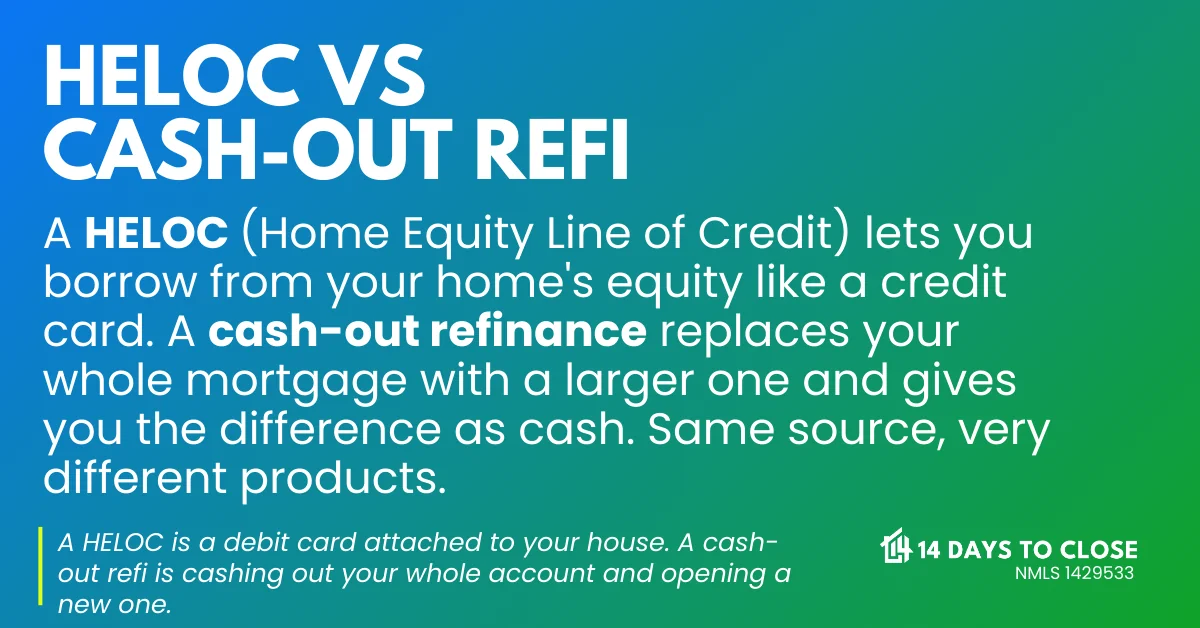
In 2026, homeowners who locked in rates at the peak of 2022 and 2023 are more likely candidates for rate-and-term refinances. Homeowners who bought earlier at lower rates but have significant equity may find cash-out refinancing worthwhile for the right project, even at a rate above their original rate, depending on the alternative cost of the funds.
At 14 Days To Close, we run the refinance math for Florida homeowners and can close a straightforward refi in under 30 days. Give us a call or start your refinance review now.