
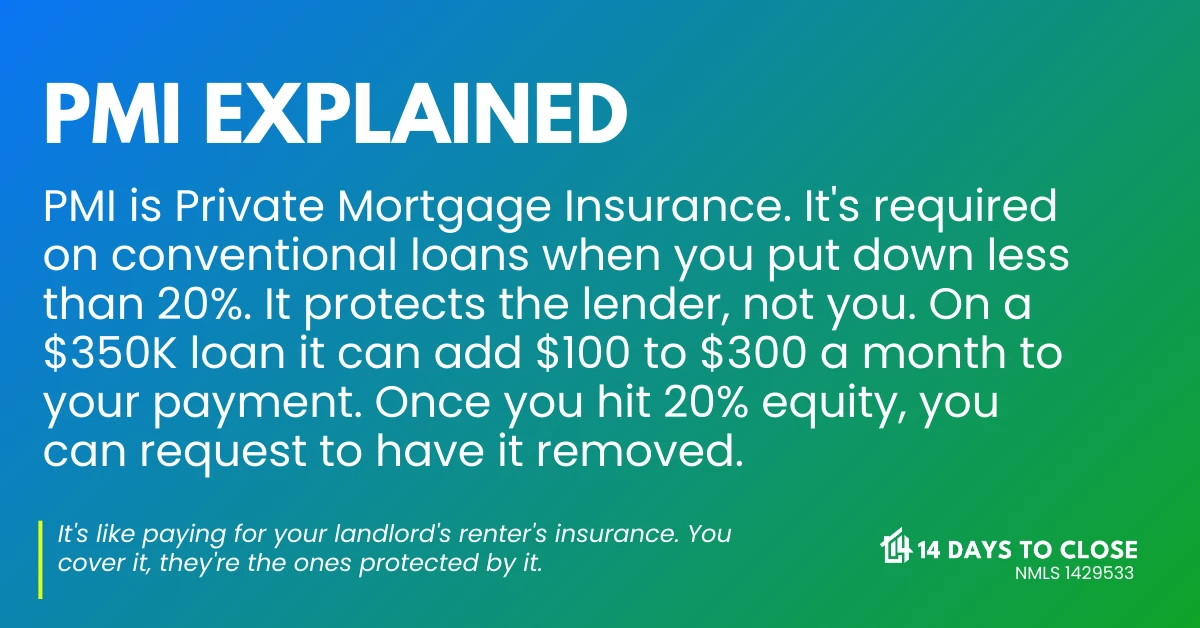
Private mortgage insurance (PMI) is required on conventional loans when you put less than 20 percent down. It protects the lender if you default, not you. You pay the premium every month, and you get nothing in return except the ability to buy with less than 20 percent down. It's not permanent, but removing it requires knowing exactly when and how to ask.
What PMI Costs
PMI typically costs 0.5 to 1.5 percent of the loan amount annually, depending on your credit score, down payment, and loan size. On a $350,000 loan with 5 percent down, you might pay $150 to $350 per month in PMI.
That's real money. Over five years, it adds up to $9,000 to $21,000 in premiums that build no equity and provide you no coverage. Understanding your cancellation timeline from day one makes sense.
Automatic Cancellation Under the Homeowners Protection Act
Federal law requires lenders to cancel PMI automatically when your loan balance reaches 78 percent of the original value (the lesser of your purchase price or the original appraised value), based on your payment schedule, not market value. At that point, cancellation is mandatory without any action required from you.
Your lender must also send you an annual statement reminding you of your right to cancel or remove PMI, so you know the cancellation is coming.
Requesting Cancellation at 80 Percent LTV
You don't have to wait for automatic cancellation at 78 percent. You can request PMI removal when your loan balance reaches 80 percent of the original purchase price based on your payments. The request must be in writing, and your payment history must be current.
This saves you money relative to waiting for the automatic 78 percent threshold, typically several months of premiums. On a $350,000 loan, that's $600 to $1,400 saved just by submitting a written request at the right time.
Using Appreciation to Remove PMI Early
Find Out When Your PMI Cancels
If you bought with less than 20% down, there's a timeline for when your PMI drops. We can pull that number for you and tell you if appreciation gives you a faster path.
If your home's value has increased and you've built equity beyond the 20 percent mark relative to the current value, not the original purchase price, you may be eligible to request PMI removal earlier through a new appraisal.
This requires being at least two years into the loan, having a loan balance below 80 percent of the current appraised value, and a clean payment history. Some lenders require five years before they'll consider current-value-based PMI removal.
In markets where home values have appreciated significantly, as has been the case in many Florida markets since 2020, this can be a powerful tool. A home purchased for $350,000 that now appraises at $430,000 with a $280,000 balance is at 65 percent LTV based on current value. Most lenders will remove PMI in that scenario.
PMI on FHA Loans Is Different
FHA mortgage insurance doesn't work the same way. FHA charges a monthly MIP (Mortgage Insurance Premium) regardless of equity. For loans with less than 10 percent down, FHA MIP is required for the life of the loan: it never cancels on its own. To remove FHA MIP, you typically have to refinance into a conventional loan once you have 20 percent equity.
For a complete breakdown of how FHA mortgage insurance premiums work and when they end, see our guide to FHA MIP explained.