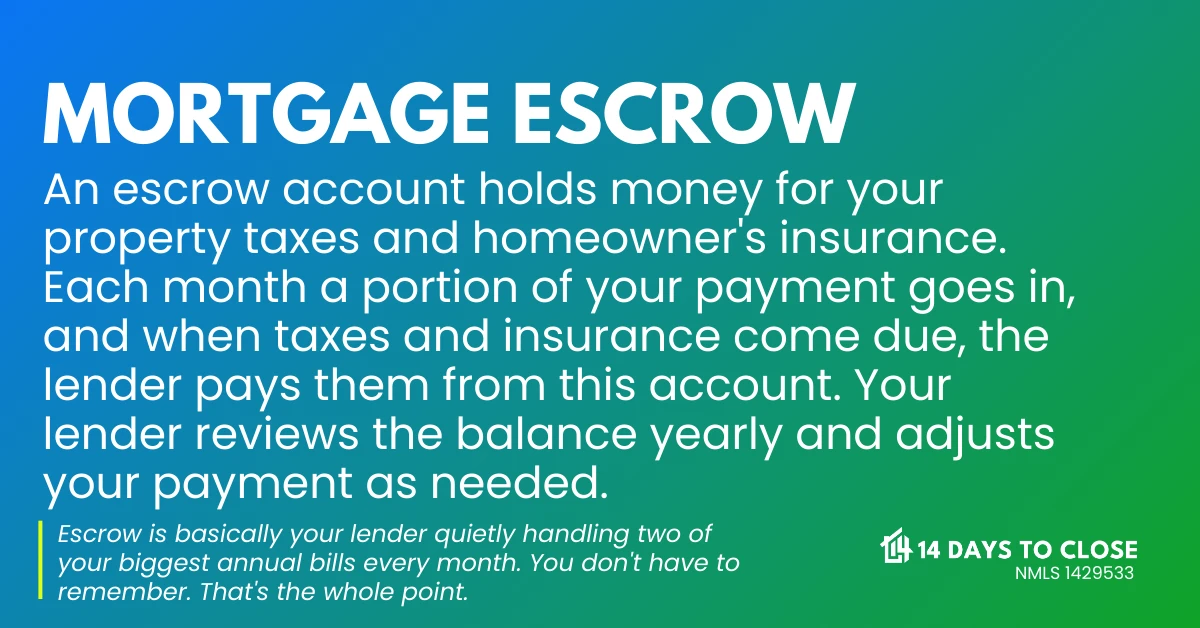
When you close on a home, your monthly payment doesn't just cover principal and interest. For most buyers, it also includes a portion set aside each month for property taxes and homeowner's insurance. That portion goes into an escrow account, a third-party holding account managed by your lender. Here's how it works and what can go wrong.
Why Escrow Accounts Exist
Lenders require escrow accounts because they have a financial interest in your property. If your homeowner's insurance lapses, your lender is exposed. If you stop paying property taxes, the county can put a lien on the home that takes priority over the mortgage. Escrow is the lender's way of making sure those bills get paid, using your money, collected in advance.
FHA and VA loans almost always require escrow. Conventional loans may allow you to waive escrow if you have at least 20 percent equity, though lenders typically charge a small fee for that privilege. Waiving escrow means you're responsible for paying your own tax and insurance bills directly, which some homeowners prefer for the cash flow control.
How the Monthly Escrow Payment Is Calculated
Your lender estimates your annual property tax and homeowner's insurance bill, then divides by 12. That amount gets added to your monthly payment. The lender also keeps a two-month cushion, called the "escrow cushion", in the account per federal law, which is why your initial escrow payment at closing includes several months of funding upfront.
For a home with $5,000 in annual taxes and $1,800 in annual homeowner's insurance, you're looking at roughly $567 per month in escrow. That's collected alongside your principal and interest payment. It's a good idea to understand these costs before closing, see our breakdown of Florida property tax advantages and homeowner tax benefits.
Escrow Analysis: The Annual Review That Can Surprise You
Every year, your lender runs an escrow analysis to compare what they collected versus what they actually paid out. If there's a surplus, meaning they collected more than they needed, you'll get a refund check. If there's a shortage, because taxes or insurance went up, you'll owe either a lump sum or see your monthly payment increase to catch up.
Property tax increases in Florida are common, especially in fast-appreciating markets. If your home's assessed value jumped significantly, your tax bill likely increased too. That shows up in your escrow analysis, sometimes as a surprisingly large shortage.
Buying in Florida and want to know your real monthly payment?
Escrow adds more to your payment than most buyers expect. We'll walk you through the full number, taxes, insurance, and all, before you commit.
Get My Full Payment BreakdownWhat Happens When Your Escrow Estimate Is Wrong
Lenders use the previous year's tax and insurance bills to estimate your escrow. If you bought a newly built home, the first tax bill is often based on vacant land, far lower than what you'll owe once the structure is assessed. When the real tax bill arrives, the lender covers the shortage, then adjusts your monthly payment going forward to make up the difference.
New construction buyers in Florida should be especially aware of this. A first-year escrow estimate based on land value can be off by thousands, and the correction shows up as a higher monthly payment in year two.
Homestead Exemption and Its Effect on Escrow
If you're a Florida resident and the home is your primary residence, you're entitled to a homestead exemption that reduces your assessed taxable value. Applying for it can meaningfully lower your property tax bill. But if your lender doesn't know you've applied, they may not adjust the escrow estimate until the next analysis.
Apply for homestead exemption with your county property appraiser's office by March 1 of the year following your purchase. Once it's granted and reflected in your tax bill, your next escrow analysis should show a surplus rather than a shortage. This is one of the steps we walk through with every Florida buyer, along with making sure nothing derails the closing timeline.
At 14 Days To Close, we walk buyers through escrow, property taxes, and total monthly payment before closing, not after.