Cash buyers think they're taking a shortcut. No mortgage application, no lender scrutiny, no closing date held hostage by underwriting. You've got the money, you make an offer, and you close. That's mostly true. But the closing process still exists.
A cash purchase compresses the timeline from 30-45 days to 7-14 days, sometimes faster. But you're still dealing with a title search, a closing attorney, inspection, and the full legal transfer of real property. Here's exactly what that looks like.

You Skip the Lender, But Not the Closing
The biggest misconception is that cash offers skip the closing entirely. They don't. A cash offer bypasses the mortgage lender, but you're still closing on real estate. That means title work, attorney fees, transfer taxes, and title insurance, everything that makes a residential property transfer legally binding in Florida.
A cash closing typically includes:
- Title search and insurance: a title company or attorney searches the property's ownership history to confirm the seller actually owns it free and clear of liens. Typically $500-1,500.
- Home inspection: optional for cash buyers, but most still get one. Skipping it means accepting the property as-is with no recourse.
- Appraisal: also optional, but wise if you plan to refinance later or want an independent value check on what you're paying.
- Attorney fees and closing costs: Florida requires a closing attorney for residential real estate. Expect $800-1,500 in legal fees plus $1,000-3,000 in transfer taxes, recording fees, and insurance premiums.
- Final walkthrough: you walk the property before closing to verify repairs were completed and the home is in the condition you contracted for.
Even without a lender, these steps take time. A motivated cash buyer can close in 7-10 days. Most cash transactions take 14-21 days.
What You Need Before You Can Even Make an Offer
Cash buyers don't present a pre-approval letter. They present proof of funds. Before a seller takes your offer seriously, they want to see that the money actually exists:
- A recent bank statement showing the full balance
- An investment account statement (brokerage, IRA, or similar)
- A letter from your banker confirming available liquid funds
- A wire transfer confirmation from your bank to escrow
Proof of funds is your version of a pre-approval letter. Without it, your offer has no weight. Serious sellers won't even schedule a showing for a cash buyer who can't produce documentation. Get this lined up before you start touring homes.
What Cash Offers Signal to Sellers
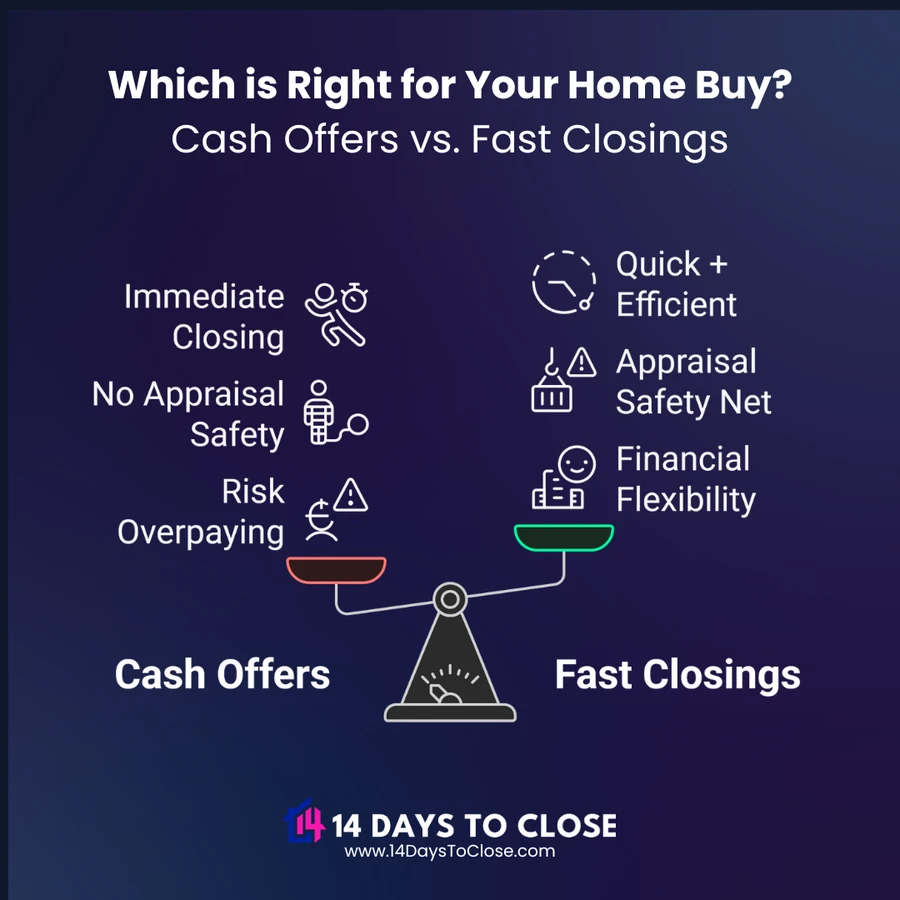
A cash offer removes the lender's risk entirely. A financed offer carries three contingencies that can kill the deal:
- Financing contingency: deal falls apart if the lender backs out
- Appraisal contingency: deal falls apart if the home appraises below contract price
- Inspection contingency: deal falls apart if inspection reveals problems
Sellers care about certainty. A cash offer, even at the same price as a financed offer, often wins because sellers can see the finish line. You're not asking for an appraisal contingency, so if the home appraises low, you're still closing at the contracted price. That certainty is worth something, especially in competitive Florida markets.
What You're Still Paying Without a Mortgage
Cash buyers save on interest. Over 30 years on a $400,000 mortgage at 6.5%, that's roughly $330,000 in interest alone. Buying cash eliminates that. No PMI, no lender fees, no origination costs.
But property ownership still costs money:
- Property taxes: in Florida, roughly 0.83% of assessed value on average. On a $400,000 home, that's around $3,300 per year.
- Homeowners insurance: typically $800-1,500 per year depending on location and property type.
- HOA fees: if applicable, $100 to $500+ monthly.
- Maintenance and repairs: roof, HVAC, plumbing, all on you as the owner.
- Closing costs: even cash buyers pay title, attorney, and recording fees. Typically $3,000-$5,000.
When Financing Actually Makes More Sense
This surprises most cash buyers: sometimes carrying a mortgage is the smarter financial move.
If your cash earns 7-8% invested in index funds and a mortgage costs 6.5%, you're earning a 1.5% spread. On a $400,000 mortgage, that's $6,000 per year in opportunity cost from paying cash. Over 30 years, that compounds significantly.
Add in the federal income tax deduction on mortgage interest, and the case for financing gets stronger. Some sophisticated buyers purchase with cash, then immediately do a cash-out refinance to pull most of their capital back and redeploy it. It's a strategy worth understanding before you wire everything to escrow.
Cash or financed, we can help you move fast.
We target a 14-day close. If you're financing instead of paying cash, get your approval locked before you make an offer.
What Happens to Your Equity After You Buy Cash
Your equity is 100% from day one. The home is yours with no lender claim on it. But that equity is locked up in the property. You can't access it without selling or taking on debt.
Options to tap equity without selling:
- HELOC (Home Equity Line of Credit): borrow against your home equity at a variable rate, paying interest only on what you draw
- Cash-out refinance: take out a new first mortgage and pull cash out at the same time, giving you a fixed rate and predictable payment
- Delayed financing: some investors buy cash, then immediately do a cash-out refi to pull 80% of their capital back and use it for additional purchases
None of these are available until you close. That's the cash trade-off: full ownership and equity immediately, but capital trapped in an illiquid asset unless you're willing to take on debt again.
At 14 Days To Close, we work with cash buyers and financed buyers across Florida. If you're trying to decide which path makes sense for your situation, learn how to get your home loan approved faster or reach out below.