
For years, the idea that you must put 20% down to buy a home has been treated like a rule. It's a myth that keeps too many people from owning a home. Today, buyers across the U.S. are getting into homes with far less. You just need to know your options.
Understanding Down Payments
What Is a Down Payment?
A down payment is the upfront money you pay toward the total cost of the home. The rest of the purchase price is covered by a mortgage loan. If you buy a $300,000 home and put down 20%, that's $60,000 out of pocket. That kind of cash isn't realistic for most buyers, especially when rent, inflation, and other costs keep rising. You don't need 20% down to get into a home.
Why Is 20% the "Gold Standard"?
Lenders like 20% down because it reduces their risk and eliminates the need for private mortgage insurance (PMI). PMI is an extra monthly fee that protects the lender in case you default. Avoiding PMI can be helpful, but it shouldn't stop you from buying if you can afford a smaller down payment. Most buyers today put down far less.
Exploring Alternatives to 20% Down
There are several popular loan options that make it easier to get started with less cash upfront. Here are three of the most common.
FHA Loans
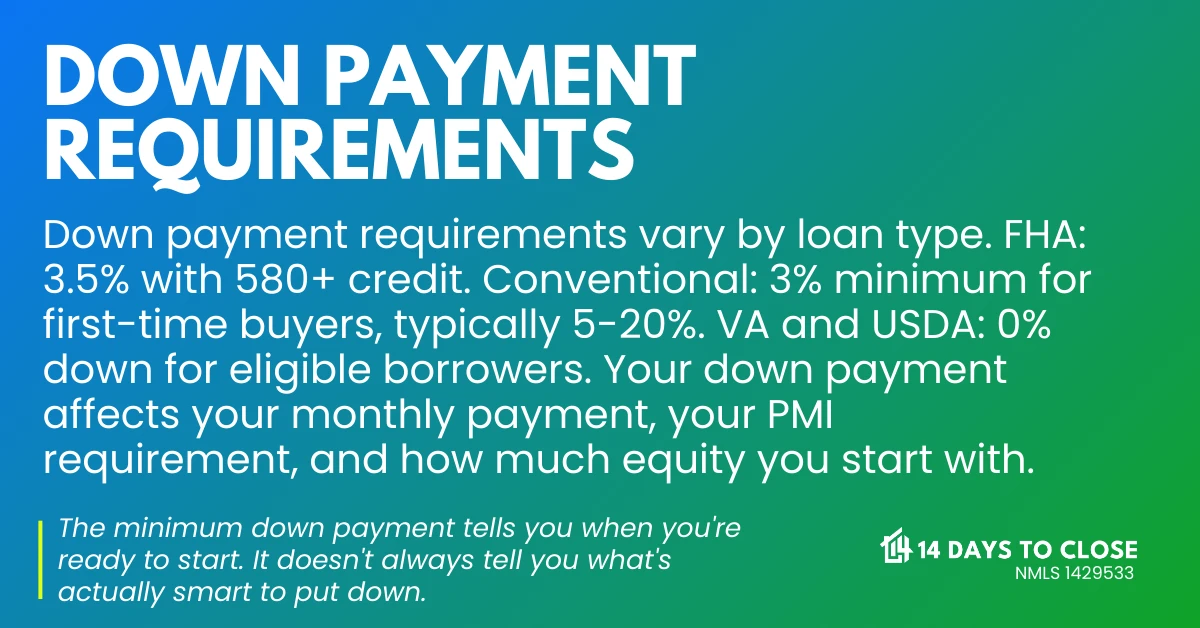
FHA loans are backed by the Federal Housing Administration and are one of the most popular low down payment options. You can qualify with as little as 3.5% down and a credit score as low as 580. These loans are ideal for first-time homebuyers and people with moderate incomes. They do require mortgage insurance, but many buyers find the trade-off worth it to get into a home sooner. To see if you qualify, start your pre-approval here.
VA Loans
If you're a veteran, active-duty service member, or a surviving spouse, VA loans may be your best option. These loans are backed by the Department of Veterans Affairs and offer zero down payment, no PMI, and competitive interest rates. It's one of the most powerful benefits available to military families, and yet millions of eligible buyers don't realize they qualify.
Conventional Loans
Conventional loans are not backed by the government but are still a strong option. Many allow down payments as low as 3%, especially for first-time homebuyers. You'll likely pay PMI if you put down less than 20%, but it can often be removed once you build up enough equity. With good credit and solid income, a conventional loan can offer flexibility without the high upfront cost.
Down Payment Assistance Programs
Many local and state programs offer grants or second loans to cover part of your down payment and closing costs. Some are based on income, others on location or profession. Teachers, first responders, and healthcare workers often qualify for special help. Florida has millions in down payment help that most buyers never claim, and it's worth reviewing what's available before you assume you're on your own.
How Market Conditions Affect Your Down Payment
In a buyer's market, there are typically more homes for sale than there are buyers. That puts the power in your hands. With less competition, sellers are often more willing to negotiate, which can mean help with closing costs, accepting a lower down payment, or even buying down your interest rate. Timing your purchase during these conditions can save you thousands.
Even with a low down payment, you still need to plan for closing costs, which usually range from 2% to 5% of the loan amount. Some loan programs allow you to roll closing costs into the loan or negotiate with the seller to cover them. Working with a team that knows how to structure deals matters here.
Understanding Loan-to-Value Ratio and Mortgage Insurance
Your loan-to-value (LTV) ratio is the percentage of the home's value you're borrowing. If you're buying a $250,000 home and putting $25,000 down, your LTV is 90%. A lower LTV typically means better loan terms, but many lenders approve loans with LTVs of 95% or higher.
A higher LTV often means you'll need mortgage insurance. That could be PMI for conventional loans or a mortgage insurance premium (MIP) for FHA loans. VA loans don't require monthly mortgage insurance. While it's an added cost, many buyers view it as a short-term trade-off to get into a home sooner. Once you've built enough equity, you may be able to remove or refinance out of it. For a full breakdown of how FHA mortgage insurance actually works, that guide is worth a read.
Debunking Common Myths
A lot of buyers pause their home search because of outdated or flat-out wrong information. The homebuying process has evolved, and there are more options than ever to help you get in without draining your bank account. Here are three myths that keep people on the sidelines.
Myth 1: You must always put 20% down. False. With FHA, VA, and conventional loans, you can get into a home with as little as 0% to 3.5% down.
Myth 2: Lower down payments mean higher risk. Not always. What matters more is how well you manage the monthly payments. If you're financially stable with steady income, a smaller down payment can make more sense than waiting years to save.
Myth 3: Only conventional loans exist. FHA, VA, and USDA loans are all government-backed and designed to help buyers who don't fit the conventional mold. There are also hundreds of down payment assistance options across the country.
See exactly which loan fits your situation
Jordan can walk you through FHA, VA, and down payment assistance options in one conversation. No bank runaround.
What to Do Instead of Waiting for 20%
The 20% rule is outdated. The real question isn't whether you need 20% down. It's what the smartest path is for you based on your current finances. At 14 Days To Close, we help buyers discover flexible loan options, down payment help, and fast-track approvals. Our team works evenings and weekends to guide you every step of the way.
Start your journey today with a free pre-approval, or schedule a one-on-one call to talk through your options. We close fast, and we're ready when you are.