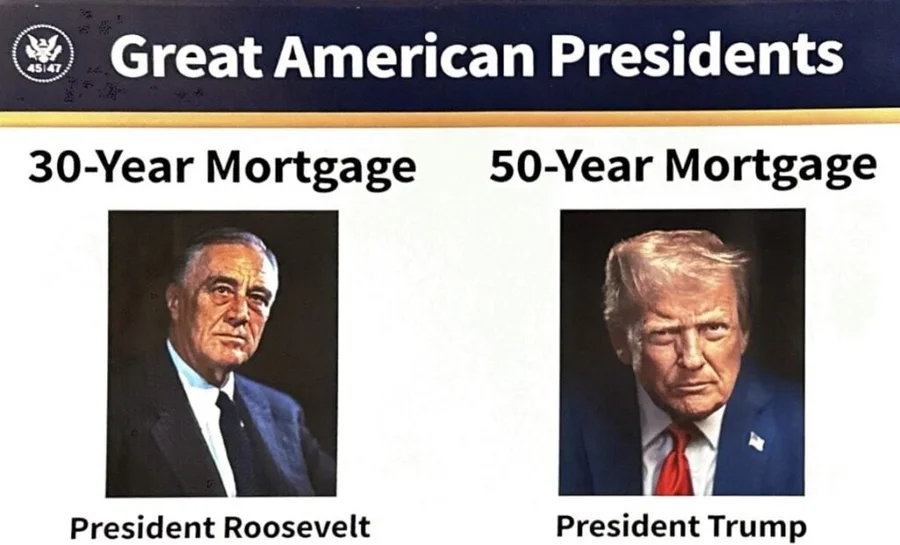
When President Trump floated the idea of a 50-year mortgage on November 8th, the reactions came fast. Some people loved the thought of lower monthly payments. Others said it sounded like a trap that would keep homeowners paying interest forever. Even high-profile investors like Kevin O'Leary weighed in. Since there's no official plan yet, the best way to understand it is to look at how a 50-year mortgage would actually behave with real numbers.
Most buyers are used to the 30-year mortgage. Stretching the timeline to 50 years does make the payment smaller, but it adds twenty more years of interest. That's where things get complicated.
How a 50-Year Mortgage Changes Your Monthly Payment
The savings on your monthly payment are real but smaller than most people expect. Here's a straightforward example using a $350,000 loan at 6%.
| Loan Term | Rate | Monthly Payment | Total Interest |
|---|---|---|---|
| 30 years | 6.0% | $2,098 | $405,434 |
| 50 years | 6.0% | $1,842 | $755,450 |
| 50 years | 6.5% | $1,973 | $833,805 |
The monthly savings on the 50-year at 6% come out to about $256. That helps, but it's not the dramatic drop most people picture. And here's the part most buyers miss: inflation erodes that $256 over time. Fifty years ago, in 1975, $256 had the buying power of about $1,545 today, a more than 500% jump. So the real value of your "savings" shrinks decade after decade, while the extra interest you owe stays fixed and very real.
If lenders charge a higher rate for the longer term (which is likely, since it takes them longer to get their money back), the math gets heavier. At just half a point more, 6.5%, the monthly payment climbs back to $1,973 and total interest tops $833,000. That's $428,000 more than the 30-year version. Use the mortgage calculator to run these numbers with your actual loan amount and see the real tradeoff before making any decisions.
Equity Builds Slower Than You'd Think
Homeownership builds wealth through equity. The faster you pay down the loan, the faster you build financial stability. A 50-year mortgage slows that down almost to a crawl.
In the first five years, here's how much principal you'd actually pay off:
- 30-year mortgage at 6%: about $24,310
- 50-year mortgage at 6%: about $6,448
- 50-year mortgage at 6.5%: about $5,454
After five years on a 50-year note, you barely own more of the home than the day you closed. Most of every payment is going to interest. That makes it harder to move, refinance, or pull equity later. You get stuck in starter-home mode longer than intended.
See what today's loan options actually cost you.
We'll walk you through the real numbers on 30-year, 15-year, and any other structure you're considering, in plain English, no pressure.
Start My Pre-ApprovalDoes a 50-Year Mortgage Actually Make Housing More Affordable?
Short term, a slightly lower payment might help a few buyers squeeze into the market. But it doesn't fix the underlying issues. Home prices are high, supply is limited, and first-time buyers are now entering the market around age 40 on average. Stretching the mortgage to 50 years just pushes full ownership closer to retirement age. A couple hundred dollars a month isn't enough to change that math.
Long term, the tradeoff gets harder to ignore. You pay far more in interest and build equity at a much slower pace. For most buyers, that's not a trade worth making. Understanding the full picture is what separates a good decision from one you'll regret in year 15. Our guide to how mortgage rates affect your total loan cost goes deeper on this if you want to see how rate differences compound over time.
So Is a 50-Year Mortgage Worth It?
The monthly payment goes down a little. The total cost goes way up. Equity builds at a snail's pace. Trump's mention of the concept brought it back into the spotlight, but the numbers make it a hard sell for most buyers.
If you want to compare real, practical mortgage options that actually fit your situation, our team is available nights, weekends, and whenever you need an honest conversation about your options. Give us a call, and you can schedule a call whenever it works for you.