Side-by-Side
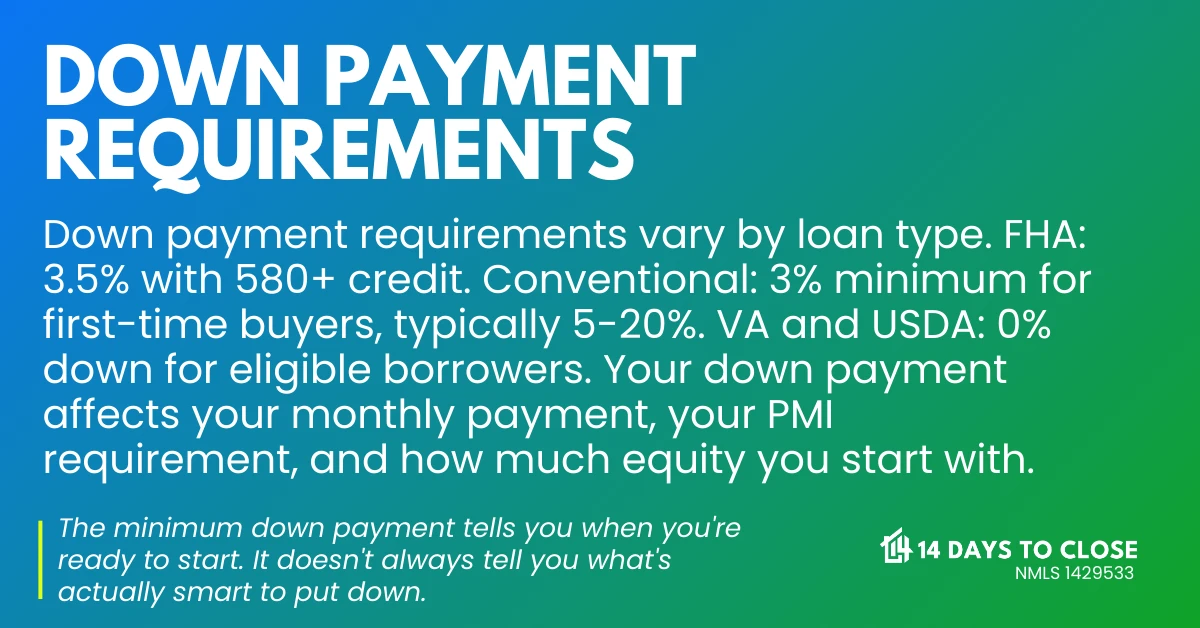
Down Payment Requirements by Loan Type
One of the biggest factors in choosing a loan type is how much you need to bring to closing. Here's how the numbers stack up.
FHA, VA, USDA, conventional, jumbo, DSCR. Six loan types, six different sets of rules. The right one depends on your credit, your down payment, your service history, and where you're buying. Here's how each one works.
Most buyers come in thinking they only have one option. That's rarely the case. A buyer with a 640 credit score and 5% saved might qualify for FHA, conventional, and USDA depending on the property location. The question isn't just "which loan can I get?" , it's "which loan costs me the least over time?"
Down payment, mortgage insurance, interest rate, and loan term all change depending on which product you use. That's why the conversation matters before you start house hunting. When you know your loan type going in, your offer carries more weight and your closing timeline gets shorter.
Here's a breakdown of every major loan type we close at 14 Days To Close, what each requires, and who it's designed for.
FHA loans are backed by the Federal Housing Administration. They're designed to make homeownership reachable for buyers who don't have perfect credit or a large down payment saved up.
FHA loans have higher insurance costs than conventional, but the lower credit and down payment thresholds make them the most accessible option for many buyers. If you've had a bankruptcy or short sale, FHA also has shorter waiting periods than conventional. Learn more about FHA loans in Florida.
VA loans are guaranteed by the Department of Veterans Affairs and available to veterans, active-duty service members, and surviving spouses who meet eligibility requirements. It's one of the strongest loan products ever created.
If you qualify for VA, you should almost always use it. No down payment and no PMI together can save tens of thousands over the life of the loan. We've closed VA loans in 11 days. See how VA loans work in Florida.
USDA loans are backed by the U.S. Department of Agriculture and offer zero-down financing in eligible rural and suburban areas. More Florida zip codes qualify than most buyers expect , including many areas around Tampa, Orlando, and Jacksonville.
USDA is often overlooked because buyers assume they don't live in a qualifying area. Check before you rule it out. The income limits are higher than most people think, and the zero-down advantage is significant. Check USDA eligibility in Florida.
Conventional loans aren't backed by the government , they conform to guidelines set by Fannie Mae and Freddie Mac. They're the most widely used loan type and work for primary homes, second homes, and investment properties.
Conventional loans usually have lower total insurance costs than FHA once your credit score is above 680 or so. If you're putting 20% down, the math almost always favors conventional. It's also the only option for second homes and most investment properties.
Jumbo loans cover properties where the purchase price exceeds the conforming loan limit set by the Federal Housing Finance Agency (FHFA). In most Florida counties, that limit is $806,500 in 2026. Go above that and you're in jumbo territory.
Jumbo underwriting is stricter because there's no government backing. Lenders are taking more risk, so they want to see stronger credit, lower debt ratios, and more cash reserves. We've closed jumbo loans inside 14 days for buyers with clean files. Learn how jumbo loans work in Florida.
DSCR stands for Debt Service Coverage Ratio. These are non-QM loans designed for real estate investors who want to finance rental properties without using personal income to qualify. The loan is underwritten on the property's cash flow, not your W-2 or tax returns.
If you're building a rental portfolio or buy properties through an LLC, DSCR is often the cleanest path. You're not penalized for business write-offs that reduce your taxable income , the property just needs to carry itself. See how DSCR loans work.
One of the biggest factors in choosing a loan type is how much you need to bring to closing. Here's how the numbers stack up.
| Loan Type | Min. Down | Min. Credit | Mortgage Insurance | Best For |
|---|---|---|---|---|
| FHA | 3.5% | 580 | Required (MIP) | First-time buyers, lower credit scores |
| VA | 0% | No set minimum | None | Veterans, active duty, surviving spouses |
| USDA | 0% | 640 (typically) | Annual fee, lower than FHA | Rural/suburban buyers, moderate income |
| Conventional | 3–20% | 620 | Required under 20% , cancellable | Buyers with good credit, investment properties |
| Jumbo | 10–20% | 700+ | Usually none with strong file | High-value purchases above conforming limit |
| DSCR | 20–25% | 620 (varies) | None typically | Investors, LLCs, rental properties |
A 10-minute conversation is all it takes. Jordan will tell you which loans you qualify for, what each one costs you, and which one makes the most sense for your situation.
Most lenders specialize in one or two products. We handle all six , so you're never being steered toward a loan because it's the only one we offer.
Start a pre-approval and we'll match you to the right loan type based on your actual file , not a generic recommendation.